










When businesses are born, business owners are likely not daydreaming about taxes and payroll. Yet, they still face the unique challenge of figuring out how to pay themselves, file their taxes, and maximize their tax savings.
As their business grows, many business owners opt for S-corporation Election due to the tax advantages it presents, but they must be mindful of how much they pay themselves, in order to remain compliant in the eyes of the IRS. Unless they moonlight as an experienced accountant, self-payment and tax filing can be confusing and stressful for small business owners – understandably so!
Like most things involving taxes, it gets complicated. That is why we have created this comprehensive guide to help business owners pay themselves and maximize their savings as an S-corporation!
How to Pay Yourself as an S-corporation: Salary and Distributions
Under other business structures, you simply take a share of company profit as your payment. In an S-corporation, you have the option to pay yourself in two ways:
- Salary, your wages or reasonable compensation. This is considered taxable income to the payee by the IRS.
- Distributions, the earnings that are paid as distributions to you as the owner. These are not employee wages and are not taxed as self-employment income in an S-corporation.
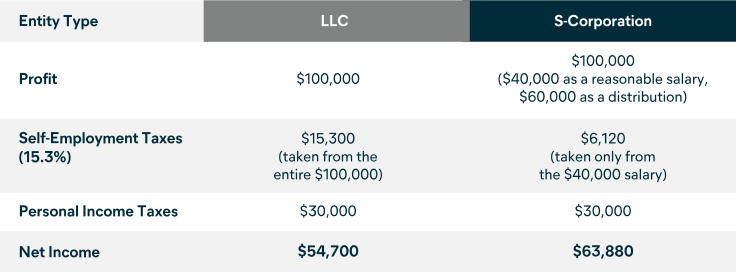
For example, if your business produced $100,000 in profit, you could take a reasonable salary of $40,000, and the remaining $60,000 as a distribution. It may seem strange to receive payment in two different forms, but it comes with significant tax savings, which will be discussed shortly.
How Much Do I Pay Myself as an S-corporation?
The short answer is, it depends.
S-corporation shareholder-employees are required to receive a reasonable salary, which is generally defined as at least what other businesses would pay someone in that role for similar services. Every business is different, so the exact amount that business owners pay themselves will vary.
To determine your reasonable salary, you can start with the U.S. Bureau of Labor Statistics, which provides insight into compensation across different industries. This will give you an idea of what you should be paying yourself based on your field and the profit you produce.
Some of the factors the IRS considers to determine a reasonable salary are:
- Training and experience
- Duties and responsibilities
- Time and effort devoted to the business
- Distribution history
- Payments to non-shareholder employees
- Timing and manner of paying bonuses to key people
- What comparable businesses pay for similar services
- Compensation agreements
- Use of a formula to determine compensation
You must be careful to pay yourself a reasonable salary. Paying yourself a salary that is too low (or none at all) can draw scrutiny from the IRS, as it is considered an attempt to avoid paying self-employment taxes.
The good news is that you do not have to figure it all out on your own! The xendoo team is more than happy to help you determine your reasonable salary. Speak to one of our online accountants to learn more.
How Do I Pay My Taxes as an S-corporation?
The first step is to elect to be taxed as an S-corporation. To qualify for S-corporation status, your business must meet the following requirements:
- Your business must be incorporated in the United States.
- Your business may only have certain types of shareholders, including individuals, and certain trusts and estates. They may not be partnerships, corporations, or non-resident alien shareholders.
- Your business cannot have more than 100 shareholders.
- Your business can only have one class of stock.
- Your business cannot be an ineligible corporation (i.e. certain financial institutions, insurance companies, and domestic international sales corporations).
If your business meets all of this criteria, you can move forward by filing Form 2553, and sending it to the IRS. If your company has multiple shareholders, each of them must sign and submit this form as well. Once approved by the IRS, you will file your S-corporation taxes using Form 1120S.
To minimize error and maximize tax savings, partner with an online Tax CPA at xendoo. We file your taxes for you so you can focus on growing your business.
What are the Tax Advantages of Filing as an S-corporation?
No Double Taxation
C-corporations are taxed twice, with the business paying corporate income taxes, and shareholders paying taxes on their share of the income. On the other hand, S-corporations are not subject to corporate income tax. Instead, shareholders file a Schedule K-1 along with Form 1120S, which reports their share of the company’s profits or losses. This allows S-corporations to avoid double taxation.
No Self-Employment Taxes (on Distributions)
Another key advantage of S-corporations Election is that the distributions owners receive are not subject to self-employment taxes!
Every small business must pay self-employment taxes to fund social security and medicare. If your business operates as an LLC, you are required to pay self-employment taxes on your entire share of the profit, regardless of how you use the money. On top of that, you will also be taxed at your personal income tax rate. As the owner of the S-corporation, you only pay self-employment taxes on your reasonable salary. The distributions you take are exempt from self-employment tax!
To illustrate, let’s revisit the example from earlier:
Your business makes $100,000 in profit.
As a single-member LLC, you will pay $15,300 in self-employment taxes.
If you file the S-corporation Election, you pay yourself a reasonable salary of $40,000. The remaining $60,000 is taken as a distribution from profit. You will pay $6,120 in self-employment taxes only on your salary. The remaining $60,000 is exempt, resulting in a tax savings of $9,180 compared to the LLC!
For quick reference, take a look at the chart below:
S-corporation Election is a simple, yet effective, way to maximize your tax savings. Are you ready to take the next step? Schedule a free consultation with a xendoo accountant today!
xendoo is Here for You
You are not alone as you navigate the waters of self-payment and tax filing. xendoo Online Bookkeeping, Accounting, and Tax is here to help! We move at the speed of business, so you can make informed decisions faster – like deciding if an S-corporation Election is right for your business!
Want to learn more about the different business entity types? Click here.
Click here to access Form 2553.