












FREE Review of Your Books Learn More ›
a map of florida

How to Report Florida Sales Tax

Small Business Tips xendoo Team
Share this article

Whether you’re a brick-and-mortar business located in Florida or an e-commerce seller who ships to customers in the state, one hassle you can’t get away from is collecting and remitting the state sales tax.

The first thing you need to know is that Florida is a destination-based sales tax state. That means you’ll charge customers the Florida tax rate, not the rate of whatever state their purchase shipped from. Currently, the Florida sales tax is:
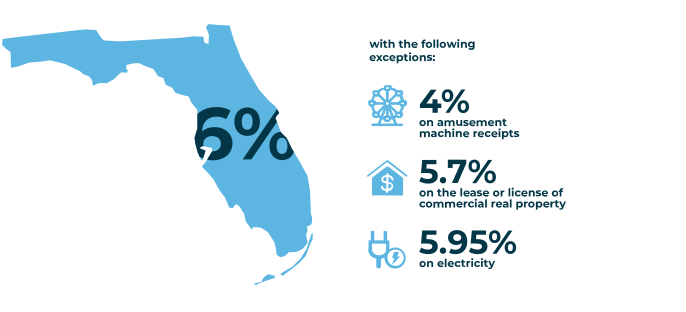
Complicating things even further is that many counties in Florida also have a discretionary surtax. For a list of the counties and their tax rates, visit the Florida Department of Revenue’s Discretionary Sales Surcharge page.Before you get started, gather the information you’ll need, including:

  • Records of sales and taxes collected
  • Your Florida sales and use tax certificate number
  • Your state-assigned filing frequency
  • Your Florida electronic filing log-in details (user name, password)
  • Bank routing and account numbers from which you’ll make the sales tax payment

To file your sales tax return, you’ll need Form DR-15. To submit a physical return with a check or money order payment, print out the form from here.The Florida Department of Revenue also provides instructions on filling out Form DR-15.To file and pay your sales tax online, start at the Florida Sales and Use Tax, Prepaid Wireless E911 Fee, and Solid Waste Tax, Fees and Surcharge Website (which is the same place you’ll be directed to if you start on the Florida Department of Treasury’s home page, and click on the “File and Pay” box).From there, follow the steps outlined in Florida’s e-File and ePay instructions.
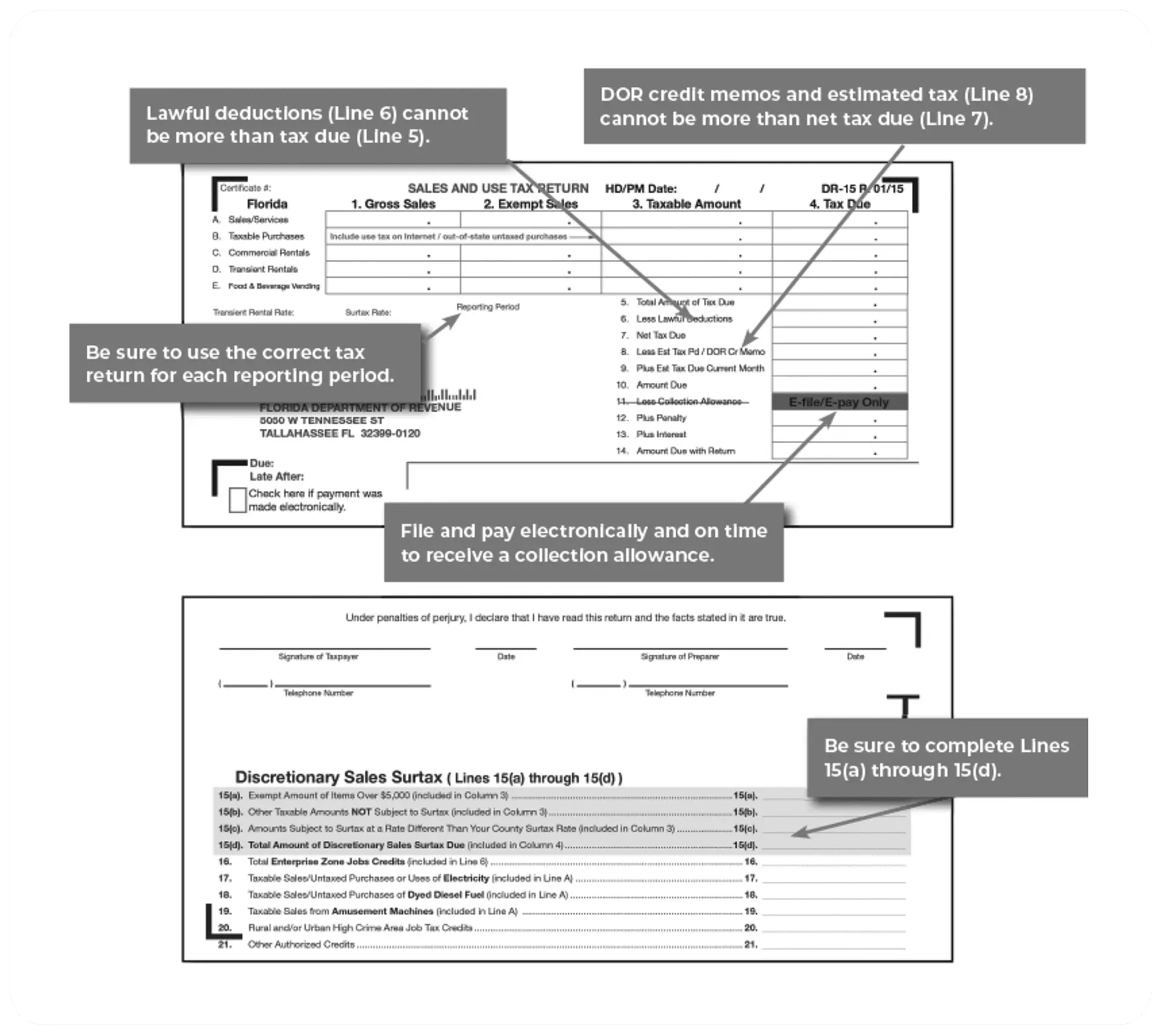
You can also print out a comprehensive tutorial if you want to keep it in your office. If you’re a new business, you will first need to register for a Florida sales tax permit (the permit number will be needed on your sales tax filing). Find information and application forms on the Florida Department of Revenue’s Account Management and Registration page. Right about now, you’re probably thinking that all this red tape is not fun — and not what you thought you’d spend your time doing when you went into business. That’s what xendoo is here for. We’ll handle all the sales tax calculations, reports and payments — even if you’re selling in all 50 states (each of which has their own rules and regulations). Now you can get back to doing the fun parts of your business!


[av_sidebar widget_area=’Blog Post Disclaimer’ av_uid=’av-om2w’]

Related Articles

Protecting Profit Margins

Where Profit Slips: How to Control Costs and Protect Margins

Where Profit Slips: How to Control Costs, Protect Margins, and Keep More of What You Earn Revenue can grow. Sales can increase. Your bank balance can still feel tight. Profit does not disappear all at once. It erodes in small, consistent ways across your business. Cost creep. Margin compression. Untracked spending. This is where profit […]

Read More
Business owner reviewing monthly reports

The Financial Reports Every Business Owner Should Review Monthly

Financial decisions rely on what your numbers show. Not guesses. Not assumptions. Not a bank balance check. Clear, consistent reporting creates visibility into performance, position, and cash movement. When reviewed monthly, these reports show where the business stands and where it is headed. Here are three reports to review each month. 1. Profit and Loss […]

Read More

How Organized Bookkeeping Simplifies Tax Season

Tax season highlights the quality of a business’s financial records. Every deduction, revenue figure, and tax calculation depends on the accuracy of the company’s books. When bookkeeping stays organized throughout the year, tax preparation becomes a structured process instead of a last-minute effort to track down missing information. Well-maintained books allow accountants to review financial […]

Read More

Why AI Is Reshaping Accounting — and How Xendoo Is Leading the Shift

Artificial intelligence has moved beyond experimentation and into the operational core of modern businesses. Companies are no longer asking whether AI belongs in their workflows. They are evaluating how deeply it should be integrated. Accounting is one of the areas where this shift has the greatest impact. Financial data influences hiring decisions, expansion plans, access […]

Read More

Why Accurate Bookkeeping Across Franchisees Is Critical for Franchisors

Franchise systems depend on financial consistency. Every franchisee operates under the same brand, pricing model, operational framework, and unit economics. However, without standardized and accurate bookkeeping across locations, franchisors lose visibility into system performance, unit economics, and financial benchmarks. Accurate bookkeeping at the franchisee level is not only an operational necessity. It directly affects financial […]

Read More

Client Accounting Services vs Traditional Accounting

Accounting is a core part of running a business. It affects how performance is measured, how decisions are made, and how confidently a business can plan. As businesses have grown more complex, the way accounting is handled has evolved as well. Today, there are different models for managing accounting work. Traditional accounting and Client Accounting […]

Read More

Why SaaS Businesses Are Switching to Remote Bookkeeping

For many SaaS businesses, bookkeeping starts as an internal task. A founder handles it. An ops lead owns it part-time. Eventually, a junior hire takes it on. That approach works until the business scales. As subscriptions grow, transactions multiply, and revenue models become more complex, bookkeeping stops being a background task and starts influencing real […]

Read More
Free Consult