













Franchise systems depend on financial consistency. Every franchisee operates under the same brand, pricing model, operational framework, and unit economics. However, without standardized and accurate bookkeeping across locations, franchisors lose visibility into system performance, unit economics, and financial benchmarks.
Accurate bookkeeping at the franchisee level is not only an operational necessity. It directly affects financial disclosures, franchise sales, performance analysis, and the long-term scalability of the franchise system.
Franchise System Performance Depends on Reliable Unit-Level Financial Data
Franchisors rely on franchisee financial data to understand how the system performs. This includes evaluating revenue trends, expense ratios, labor efficiency, and unit-level profitability.
When franchisee bookkeeping is inconsistent, delayed, or unstructured, system-wide performance becomes difficult to measure accurately.
This creates gaps in visibility such as:
- Inconsistent revenue reporting across locations
- Inaccurate expense categorization
- Limited ability to benchmark performance between units
- Delays in identifying operational issues
- Reduced confidence in financial reporting
Reliable bookkeeping across all franchisees creates a clear financial picture of the entire system.
Standardized Chart of Accounts Enables System-Wide Comparability
A standardized chart of accounts ensures that every franchisee records financial activity using the same structure. This allows franchisors to compare performance across locations accurately.
Without a standardized chart of accounts, the same expense may be categorized differently between franchisees. For example, one franchisee may record merchant fees under bank fees, while another records them under cost of goods sold. These inconsistencies distort system-wide analysis.
A standardized structure ensures consistency across:
- Revenue categories
- Cost of goods sold
- Labor expenses
- Occupancy costs
- Marketing expenses
- Operating expenses
This consistency allows franchisors to analyze unit economics with precision.
Accurate Books Support Financial Performance Representations Under FDD Item 19
Item 19 of the Franchise Disclosure Document (FDD) allows franchisors to present Financial Performance Representations (FPRs), which help prospective franchisees understand potential unit performance.
These representations must be based on accurate, reliable financial data.
If franchisee bookkeeping is inconsistent or inaccurate, franchisors face limitations in presenting meaningful Item 19 disclosures.
Accurate franchisee books allow franchisors to:
- Calculate average unit revenue
- Measure expense ratios across locations
- Present reliable profit benchmarks
- Support defensible financial disclosures
- Strengthen franchise development efforts
Reliable financial data strengthens credibility with prospective franchisees.
Financial Visibility Allows Franchisors to Identify High- and Low-Performing Units
Standardized bookkeeping allows franchisors to identify performance trends across locations.
This visibility helps franchisors:
- Identify top-performing units
- Detect underperforming locations early
- Analyze operational efficiency
- Understand cost structure differences
- Improve system-wide performance
Without accurate financial data, these insights are limited.
System-Wide Financial Visibility and Benchmarking Through ZorConnect
Standardized bookkeeping becomes more valuable when franchisors have direct, centralized visibility into franchisee financial data. Without a unified reporting layer, financial information remains fragmented across locations, limiting the ability to evaluate performance across the system.
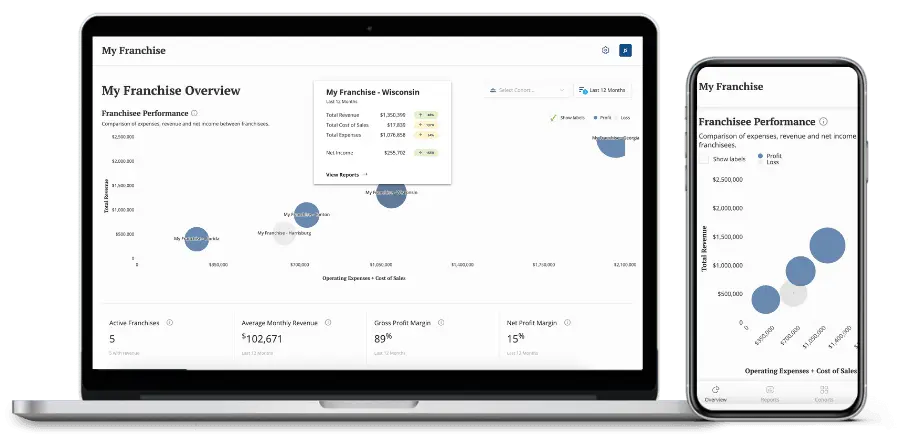
ZorConnect provides franchisors with a centralized dashboard designed for franchise financial oversight. The platform aggregates franchisee financial data into a single view aligned with the franchisor’s standardized chart of accounts.
This allows franchisors to:
- View revenue and financial performance across all franchise locations in one dashboard
- Benchmark locations against each other using consistent financial categories
- Identify which franchisees and locations are performing at the highest level
- Detect underperforming units earlier and support operational improvements
- Monitor system-wide financial trends in real time
- Access standardized reporting without manual data collection
By combining standardized bookkeeping with centralized reporting and benchmarking, franchisors gain clear visibility into unit performance and overall system health.
Standardized Financial Reporting Strengthens Franchise System Stability
Franchise systems operate most effectively when financial reporting follows consistent standards across all locations.
This provides franchisors with:
- Reliable system-wide performance data
- Comparable unit-level reporting
- Accurate financial benchmarks
- Stronger franchise development support
- Clear operational visibility
Financial consistency strengthens the franchise system as a whole.
[elementor-template id=”72586″]